Questions and Answers on Proving Astrology with a Perceptron
Note: the study itself is published below, after this question-and-answer block. Since the same questions about my work keep coming up on social media, I have gathered them into this section.
Question: What is a horoscope (and a cosmogram) from the standpoint of modern science?
Answer: The most fitting model I can offer to answer this question is a "roulette wheel". Our roulette wheel will have only 12 pockets – these are the signs of the Zodiac, but there will be from one (rarely) to 9 or even more "balls". Each of these balls: the Sun, the Moon, Mercury, Venus, Mars, Jupiter, Saturn, Rahu and Ketu (the lunar nodes), sometimes Uranus, Neptune and Pluto, - moves at its own speed, with certain characteristic patterns that fully obey the laws of physics (in this case, astrophysics). Some balls may slow down, stop and then move in the opposite direction (retrograde motion), while others always move only forward (the Sun and the Moon) or only backward (Rahu and Ketu). But this motion is predictable, so we can calculate where any given "ball" will be at any moment in time.
Then a photographer takes a snapshot of the roulette wheel at an arbitrary moment and examines the position of the "balls" on it. Each "ball" turns out to be in one of the 12 pockets (signs of the Zodiac), - this is the "cosmogram", the position of the planets at the moment of a person's birth (the moment of the snapshot). But we do not know why the photographer took this snapshot and when he will decide to take the next one. This process is assumed to be completely random.
As time goes by, the people born at the moment of the "snapshot" grow up, get an education, start families and fulfill themselves professionally. We collect, for example, the "snapshots" ("cosmograms") of actresses and the "snapshots" of military men into two groups, which we then shuffle together, and it turns out that a neural network of the perceptron type, after a little training, is able to sort these snapshots (new to it - it was not trained on them) back into the two piles. Different groups of professions show different accuracy, but on average it is from 60 to 70% if the trans-Saturnian planets are not used (more on them separately, and they improve the accuracy). There are also poorly distinguishable groups of professions, but they are few.
Question: Could the neural network be distinguishing, by the positions of the planets, people born in different places - and is that where the recognition of the groups comes from? For example, in Gauquelin's data the musicians are predominantly French, while some other groups bring together people born in other countries.
Answer: Astronomical calculations of planetary positions are usually done for the center of the Earth, since shifting the calculation point to the Earth's surface - a displacement negligible on the scale of the Solar system - greatly complicates the mathematics but does not lead to any substantial refinement of the planets' positions.
If I had used a house system, something like the unequal-house Koch system (it is not used in Jyotish), then perhaps the angle between the ascendant and the Medium Coeli could tell us something about the geographic location of the native. But over the series of experiments I moved away from using houses altogether. At first I calculated only the Lagna (ascendant), which by itself says nothing about the place of birth, but later I dropped even that, and it had no negative effect on the perceptron's ability to distinguish the horoscopes (without houses they are more properly called "cosmograms") of representatives of two different professions.
Thus, the place-of-birth factor has no influence whatsoever on the neural network's ability to distinguish horoscopes. A person with one and the same chart could have been born in Paris, in London, or in Rio de Janeiro. The perceptron analyzes only the "picture" formed by the mutual arrangement of the planets, and I feed it this picture in a completely abstract form, sometimes replacing the exact position with a 0-or-1 flag for a sign of the Zodiac in which there is no planet (0) or a planet is located (1). The result will be similar and positive (ruling out chance).
Question: In your source data from AstroDataBank the military men were born mostly in the 19th century, while the actresses were born in the 20th century. So the neural network is simply telling apart the charts ("pictures") typical of one century from those typical of the next. The same applies to M. Gauquelin's database, where the actors and musicians were born in different stretches of time.
Answer: The motion of the planets is cyclical and repeats with various periods, so a military man born in 1881 will have the same position of Jupiter and Saturn, and the same angle between them (aspect), as an actress born in 1940. But there are slow planets, such as Uranus, Neptune and Pluto, whose position can point to the century of birth. Perhaps this was behind the fact that surprised me: the neural network was able to sort horoscopes by each of these three planets alone. So I excluded them from further consideration, and the recognition performance dropped, yet still remained well above chance.
A neural network cannot reason the way a human does; it goes by numbers alone. It is a "mathematical machine" that simply computes and estimates how strongly the "image" formed while the neural network was being trained correlates with what it now receives at the input (at the sensors). During training the machine received images from both centuries, but more of some than of others. So, to rule out the influence of this factor, I carried out a further series of experiments.
I had already done something similar earlier, when training and recognition for the actresses and military men from the ADB were performed using only three planets: Mercury, Mars and Saturn. The slowest of these three planets, Saturn, completes a full revolution in 29.5 years and cannot possibly point to the century of birth. The overall performance for these three planets came to 69% (see the table in the first study, given below).
The second obvious solution was to take the horoscopes of actors and musicians from M. Gauquelin's collection for the period from 1850 to 1899, where they occur in close numbers. In both cases this came to around 500 horoscopes, i.e. on average about 10 per year for each profession (of course, in some places there is a skew upward and in others downward — this is the average expected value). Visually, no greater "density" of the data toward the beginning of the 50-year span or its end is observed. Only a statistical study of this sample can say more precisely (on this, see the "Appendices" at the end of the page). All the years from 1850 to 1899 are filled with records of both actors and musicians, except for 1897, in which no musicians were found.
For training and recognition I used the positions of the 9 planets without the trans-Saturnian ones, which usually add a few percent to the accuracy, and without the Lagna, which usually takes 1-2% away from the overall accuracy.
The results rule out chance, overall: 65-66%, in the musicians group - 80-85%, in the actors group - 46-50% (I ran it 10 times and took the average)
Indeed, the data lying in the 20th century, where there were more representatives of one of the professions, did have a small influence on the neural network's ability to show a higher result (it was about 69% without the trans-Saturnian planets), but the presence of this spread does not fully explain the observed phenomenon, and the cause must be sought in something else.
Let me remind you that when all the records of the database from 1800 onward were used, without the trans-Saturnian planets but with the Lagna, the results were as follows: overall perf. 69%, mus. – 64%, act. 74%.
Here is a more detailed report with the technical details and the JavaScript code (everything runs right in your browser; you can open it to view and verify every stage, from the source data to the results):
Data from real horoscopes for training and testing. Selected from M. Gauquelin's database, professions: Actors and Musicians, only cases from the years 1850 - 1899. The records in the database come in arbitrary order, the years are shuffled.
This gave 507 actors and 476 musicians. Of these, the 50 cases at the end of each list were taken for recognition, and the rest (the 426 cases at the beginning of each) for training the neural network.
For each planet its longitude in the Zodiac from 0 to 1 was passed (the longitude from 0 deg. Aries divided by 360), without the Lagna and without the trans-Saturnian planets.
The order is as follows: Sun, Moon, Mercury, Venus, Mars, Jupiter, Saturn, Rahu, Ketu
The entire M. Gauquelin database, actors, only cases from 1800 onward: https://lagnalord.com/ai/AG-ACTORS.zbs
The entire M. Gauquelin database, actors (from 1800), with a link to the horoscope for checking the planetary positions: https://lagnalord.com/ai/ag-act-all--ts-la.html
A sample from M. Gauquelin's database, actors from 1850 to 1899, with a link to the horoscope for checking the planetary positions: https://lagnalord.com/ai/ag-act-1850-1899--ts-la.html
The entire M. Gauquelin database, musicians, only cases from 1800 onward: https://lagnalord.com/ai/AG-MUSICIAN.zbs
The entire M. Gauquelin database, musicians (from 1800), with a link to the horoscope for checking the planetary positions: https://lagnalord.com/ai/ag-mus-all--ts-la.html
A sample from M. Gauquelin's database, musicians from 1850 to 1899, with a link to the horoscope for checking the planetary positions: https://lagnalord.com/ai/ag-mus-1850-1899--ts-la.html
You can find the row you need by the hid variable, which holds the row number starting from zero.
I looked through the records from 1850 to 1899 - both actors and musicians were born in every year, except for 1897, which has no records for musicians.
There is no predominance of records "visible to the eye" among the actors or the musicians toward the beginning or the end of the fifty-year span; only a statistical study can give a more precise assessment.
The file with the data for training and recognition: https://lagnalord.com/ai/obnie-acts-mus-plp-ga-19v--ts-la.js
Launching the perceptron for training and recognition (open your browser's Console): https://lagnalord.com/ai/index-ag-acts-mus-19--ts-la.html
Expected performance: overall - 65-66%, in the musicians group - 80-85%, in the actors group - 46-50%
Question: The Sun moves more or less uniformly, and on the same dates of the year it occupies the same degree of the ecliptic with only a small margin of error. Perhaps the machine has simply learned to sort those born by month? For example, 35 actors and 20 musicians were born in August, so the perceptron picks only actors for that spot and gets a high success rate. Then in September the picture is reversed - only 20 actors but 35 musicians - and the perceptron will "say" that everyone born in that period is a musician, again showing good results within the sample. Have you checked this possibility?
Answer: To check this, I had already removed the Sun from the training and recognition data (see the report on the first study on this page). Now I have repeated this for the sample presented above from M. Gauquelin's database of 507 actors and 476 musicians for the years 1850 – 1899. The source data contains the positions of the following planets: Moon, Mercury, Venus, Mars, Jupiter, Saturn, Rahu, Ketu. All these planets move in such a way that on the same dates of different years they can end up in very different places of the cosmogram.
Result: overall recognition 70%; musicians – 93,8%; actors 46,2%.
I did the same for planetary positions in 0-or-1 format – the result holds, though it loses a few percentage points. Note that when we pass the data in the format "a planet is in a given sign of the Zodiac (1) or not (0)", we heavily "depersonalize" the cosmogram, since the perceptron no longer knows the angular distances between the planets (the angular aspects), yet the recognition result is still far from random (50% to 50%).
And the perceptron cannot "think" like a human; it evaluates the mutual arrangement of the planets relative to one another - their pattern, their image, associations, the remoteness of one element from another within the overall picture, so to speak. It cannot switch over to the logic proposed in the question and produce results based on the kind of data analysis described there.
If we asked the perceptron to sort horoscopes based solely on the position of the Sun in the Zodiac, its approach might indeed resemble the one described in the question, since in that case there are simply no associations with the positions of the other planets.
Previous attempts to recognize charts based on the position of the Sun alone, for actresses and military men from the ADB, showed that the neural network stops distinguishing the groups and always gives the same answer: every case is an actress, because they made up a larger percentage of the sample. Simply put, the neural network cannot tell the groups apart by the position of the Sun alone, nor by any other single planet up to the trans-Saturnian ones.
Question: Where does the non-uniformity of the data that the perceptron "sees" come from? Perhaps the databases you took had been deliberately (or unintentionally) rigged?
Answer: If the data in a database can be segmented or clustered, this does not prove that it was deliberately hand-picked; on the contrary, it reflects the fact that all processes in nature are wave-like, that is, cyclical, in character. Many events that can happen in winter cannot occur in summer, and vice versa. In other words, summer events and winter events group together and gather within their own season or segment.
Non-uniformity in the births of girls and boys:
https://www.demoscope.ru/weekly/knigi/polka/gold_fund04.html
As I have already written, clusters do not mean that the database was deliberately tailored to the workings of the perceptron. M. Gauquelin may not even have known about this technology, and he certainly did not use it. Processes in nature are subject to clustering and segmentation due to natural causes, such as, for example, the seasons of the year. Above I gave a link to a study dating back to Soviet times which proves that the births of girls and boys occur unevenly. This means there are periods when noticeably more boys are born, and so male professions such as "military men" may have a certain preponderance. And when the balance evens out, we may see that female professions such as "actress" get their chance to prevail in the population. So there is nothing criminal about segmentation in the data if it reflects natural processes in nature rather than being artificially created by man. I rule out the latter, because I did not create this sample, and M. Gauquelin did not fit it to the peculiarities of how a perceptron works. This sample reflects a natural cross-section; it is the result of a random process, just like the AstroDataBank DB, in which the same regularities are observed. That DB was compiled by many different people (wikipedia-style) over a long period of time and for entirely different purposes. No one ever imagined it could be used to train a perceptron.
Question: How does this study prove the existence of fate, karma, the soul?
Answer: Profession is an essential part of our fate. It happens that a person has no family, no children, not even a home of their own, yet a profession in one form or another is there, even when it is "odd-job man" or "professional beggar". If fate is "chosen" (set, manifested) at the moment of birth, we must assume that there are causes which lead to this, and that they lie in the past of the agent of fate, i.e. the jiva - the individual soul - since at the moment of birth the personality did not yet exist (it had not had time to take shape under the influence of sociocultural factors; one can only speak of individuality). Even what modern science calls "chance" or "randomness" has its causes, and they are, for the most part, quite material, tangible, objective.
The law of cause and effect (i.e. the law of "karma", which translates from Sanskrit as the law of "activity") asserts exactly this: "everything has a cause and an effect". This seems so obvious that it might not require any proof, but when it comes not to physics but to the fact that every deed will have a consequence which, directly and indirectly, immediately and in the long run, will come back upon the doer himself - it stops being obvious. The phantom of immediate gain from the action being performed eclipses the mind's ability to distinguish the long-term consequences of what has been done. But nothing comes from nowhere; therefore, if there is fate, there are also causes that shaped it, which means there is someone (a doer) who laid down those causes, sowed the seeds of karma, and must now reap the fruits of his deeds.
Can one face the consequences of all one's deeds within a single lifetime? Obviously not - most people in our life we will meet only once. A good or evil deed toward such "visitors" becomes a "letter to the future", and the answer will reach us far from soon. This is precisely what explains the need for many lives before a person's actions become impeccable and he is able to discern the consequences of his efforts, to stop identifying with them, and ultimately to free himself at least from gross karma.
Question: Why has no one previously tried to confirm or refute astrology using neural networks, in particular, using a perceptron?
Answer: Modern science is focused on "defense" technologies and on studying the material world to extract immediate benefits from it. It brushes astrology aside like an annoying fly because of the materialistic view of the world that took shape and became entrenched a couple of centuries ago. That is why, over the past three centuries, there have been no more than ten attempts to refute astrological concepts in the course of serious research, which points to the scant interest in this topic on the part of the scientific community.
If a genuine interest in proving or refuting astrological concepts had arisen among scientists, the result would have been different. I know this for a fact, because even without neural networks I obtained statistical research results that go far beyond the bounds of chance (for one example, see the link to the study: "Saturn Retrogradation and Life Span"). I hope to publish all the results later, since this may be useful not only for statistical analysis, but also for the astrological community, in order to single out the most effective prediction techniques.
The second reason is that although the perceptron has been known since the 1960s, the computing power for its effective application has appeared only in the last 10-15 years, which is what the current AI boom and the attempts to use it to prove or refute astrological concepts are connected with.
Question: Will AI replace astrologers?
Answer: For now, an NN cannot take a single step beyond what it has already learned… But its advantage over humans in the speed and volume of handling information allows modern AI to produce quite decent horoscope analytics, which an astrologer can use as an additional expert opinion.
Question (a statement): You got only what you wanted to get…
Answer: What I got is a mathematical proof - reproducible and verifiable results that can be checked online on this page or downloaded to your computer so you can study every step, from collecting the database to processing it with a neural network. Or you can do similar work yourself. Mathematics does not fulfill anyone's wishes; it reflects measurable regularities.
If you wish to dispute this result – you will have to find a refutation also expressed in the language of mathematics, i.e. in numbers. If you believe that the source database contains an error – this will be reflected in the mathematical parameters of the sample and described by statistical values, and using them as a guide it will be possible to assemble a corrected sample for experiments with it. So far (September 2026, two years since the first publication of the results) I have not received a single objection backed by numbers, nor any indication of an error in the calculations. And those sample parameters that I have managed to check using functions suggested by the Grok AI show that the source data contains no obvious flaws.
Question (a statement): Scientists will most likely simply ignore your study…
Answer: Then they are not scientists. By common understanding, a scientist is someone who strives to establish the truth in the course of studying nature, not someone who merely stretches the facts or proves the concepts they happen to like at the moment. That is why a true researcher will never walk past a phenomenon that does not fit into his model of the world, but will try to confirm or refute the assumptions and hypotheses that arise in connection with it.
Artificial intelligence (a perceptron-type neural network) distinguishes the horoscopes of people of different professions with up to 91% accuracy
This study completely closes the question of whether astrology is an exact science, leaving only the questions of how exactly the planets and human destinies are connected. If a mathematical machine is capable of consistently distinguishing the horoscopes of people of different professions with frightening accuracy, then why should we deny the same ability to an astrologer?
I began a series of statistical studies in astrology back in 2011, or even earlier. Below I want to acquaint everyone interested with some of their results. If you have any questions or comments about the materials presented here, write to me at solncev@ya.ru - Dmitry Solncev.
How Does It Work?
Different tasks may call for different models of artificial intelligence and neural networks. For pattern recognition, a model known as the "perceptron" is used very often (in Russian the spelling varies):
After a little training, this variant of the neural network is good at telling apart any two drawn symbols, for example: "A" and "B", "1" and "2", a "check mark" and a "cross", or any others.
You can see an example of this program in action here:
Draw the two symbols one at a time (instructions below).
Once the symbol is drawn on the canvas – press the English "v" (in lower case) - this is the training mode. After that, the canvas will be broken up into something like "pixels" ("dots"), which will be passed to the perceptron for its training or for recognition. Now we need to explain to the machine what it has received. In this version only two states are available: "positive" and "negative". One symbol we must present to the machine as "positive", and the other as "negative". After pressing "v" a dialog box appears, in which we click "OK" in the "positive" case, and "Cancel" in the other ("negative") case. This is how the machine understands that the data it received belongs to one of the two categories.
After that we press the English "c" to reset the canvas to its initial state. We draw a new symbol (preferably a different one) and press "v".
We enter 4-5 symbols of each of the two variants, drawing them in different ways. At this point the training can already be paused. After entering a symbol, we press the English "b" for recognition and get a message from the neural network: "positive" or "negative" depending on what it has determined. If the neural network has drawn a wrong conclusion - you can press "v" to give the system additional training and add the symbol to the set of those "learned" by the neural network.
As you can see, during training the field (the "canvas") is divided into equal squares, which can be in only two states: filled or empty. And we send to the sensors of the neural network (their number equals the total number of squares on the canvas) a one if the square is filled, or a zero if it has remained clean. During training, the neural network assigns to each input signal, as well as to all their combinations (associations), a certain "weight", and it is this weight that determines the choice in favor of one of the two possible answers.
During recognition, having received as input (on its sensors) the data for each square of the canvas, the neural network "weighs" and evaluates the "weight" of each received parameter and of their combinations (associations), calculating which of the two outcomes "outweighs" (is more probable) in the given case. As a result, we get an answer in the format "yes" ("positive", the first type of symbol is recognized) or "no" ("negative", the second type of symbol is recognized).
Following the same principle, we can pass data on a planet's position in each of the 12 signs of the Zodiac. If a sign is empty - we pass 0, and if the planet is in it - 1. The result is a "string" containing 11 zeros and a one in the cell that corresponds to the sign. In this way, step by step, we can pass the "picture" of a horoscope with the positions of all the planets under study in the signs (or in the houses, if needed).
Here is an example of such a string:
obnie[1] = [0,0,0,0,0,0,0,1,0,0,0,0, 0,0,0,0,0,1,0,0,0,0,0,0, 0,0,0,1,0,0,0,0,0,0,0,0, 0,0,0,0,0,1,0,0,0,0,0,0, 0,0,0,0,0,1,0,0,0,0,0,0, 0,0,0,0,0,0,0,1,0,0,0,0, 0,0,0,0,0,0,0,0,0,0,1,0, 0,0,0,0,0,1,0,0,0,0,0,0, 0,0,1,0,0,0,0,0,0,0,0,0, 0,0,0,0,0,1,0,0,0,0,0,0, 0,0,0,1,0,0,0,0,0,0,0,0, 0,0,0,0,0,0,0,0,0,0,0,1, 0,0,0,0,0,1,0,0,0,0,0,0,]; voz[1] = 0;
Here we form an array for training the neural network, in which the first 12 cells are reserved for the Lagna, followed by 12 each for the Sun, the Moon, Mercury, Venus, Mars, Jupiter, Saturn, Uranus, Neptune, Pluto, Rahu and Ketu. The order of the parameters being passed is not that important, because the perceptron will combine each signal on a sensor with all the others.
The array line shown above corresponds to the first horoscope from the database, which contains 1000 cases (link to the database file). In a separate variable attached to this line – "voz" – we report the "yes" or "no" flag for the horoscope criterion we are interested in. At first, this criterion was "longevity" - whether the person lived longer than the average for the database of 1000 horoscopes/cases or not.
Later I compiled a database of horoscopes of actresses (voz = 0) and military men (voz=1), and the accuracy with which the neural network proved able to tell the horoscopes apart surprised even me…
The brain.js Library
To work with the neural network, I used the brain.js library (version 1.6.1), written in JavaScript and available on GitHub:
https://github.com/brainjs/brain.js
To begin with, for training the neural network and for the subsequent recognition, a database of horoscopes was compiled based on the data of the astro.com website (AstroDataBank).
The Horoscope Database
The first database of horoscopes for the longevity study was collected for me by Maria Konstantinova, based on the data from the astro.com website
Horoscopes in the AstroDataBank carry a Rodden rating (RODDEN RATING). Where it is marked A or AA, it means that the information about the date, time and place of birth is known from written documents, for example "birth certificates", and falls into the category of accurate and highly accurate.
Maria collected the data from the website by hand, trying to cross-check it against information from Wikipedia wherever possible. Cases with doubts or uncertainty, or mismatches with Wikipedia, she rejected (whenever she found such).
We selected the charts of people who had already passed away (the date of death was required, from Wikipedia or from the astro.com website itself) with an A or AA rating, and with a birth date after 1800 (my program had ephemerides only after that date).
Not all, but many of the data on the astro.com website belong to public figures or "high-profile" cases, and they can be verified in various ways, for example by taking a name from the database and adding it to a Wikipedia or Google search, as well as to the search on the astro.com website itself.
In essence, the source data was collected, on the one hand, by a completely random selection, and on the other, from maximally reliable sources that are easy to verify.
Maria Konstantinova collected the source data for me into a convenient array:
$midg[$ng] = array(' Conaway Jeff ',1950,10,5,10,5,-5,40,43,'N',74,0,'W',2011,5,27,12,0,1);
The line contains, separated by commas: the date, time and place of birth, as well as the date of death and the sex of the native.
The complete database with calculated horoscopes in pdf.
Using a time function, the lifespan of each person was calculated in days and then converted to years.
The average age across the database came out to: 67.6953 years
Relative to this age, all the horoscopes were divided into two categories: long-livers (lived longer than the average) and short-lived (did not reach the average).
First Results
Can a neural network tell the horoscopes of long-livers from short-lived ones? 900 cases (out of 1000) were set aside for training and 100 for recognition.
The file obnie.js contains the data arrays. The file can be opened with Notepad, a text editor, or a dedicated JavaScript program.
obnie[n] is an array with the positions of the planets in the signs for training the neural network. A one is placed in the cell corresponding to the sign of the Zodiac, starting with Aries (cells 1-12). The first series of 12 cells is for the Lagna, followed by 12 cells for each planet (Sun, Moon, Mercury, Venus, Mars, Jupiter, Saturn, and so on).
voz[n] - contains 1 if the person lived longer than the database average, otherwise 0.
The same variables with the letter "t" ("test") added are for recognition by the already trained neural network.
Please do not confuse the astrological term "planet" with the astronomical one - they are different concepts. In astrology the Sun, the Moon, Rahu (the north lunar node), Ketu (the south lunar node) and Pluto are counted among the "planets". But from the standpoint of astronomy these are all different objects that have nothing to do with the concept of a "planet".
Follow this link:
Right-click on the page and choose the drop-down menu item "Inspect" or "View source" (it may be named differently in different browsers). Part of the screen will open with the page code, where you need to select the "Console" tab. Then you can press the "v" key in the English keyboard layout and you will see the program running (it takes some time, you will have to wait), at the end of which the result of recognizing one hundred test cases will appear in the console.
It looks like this:
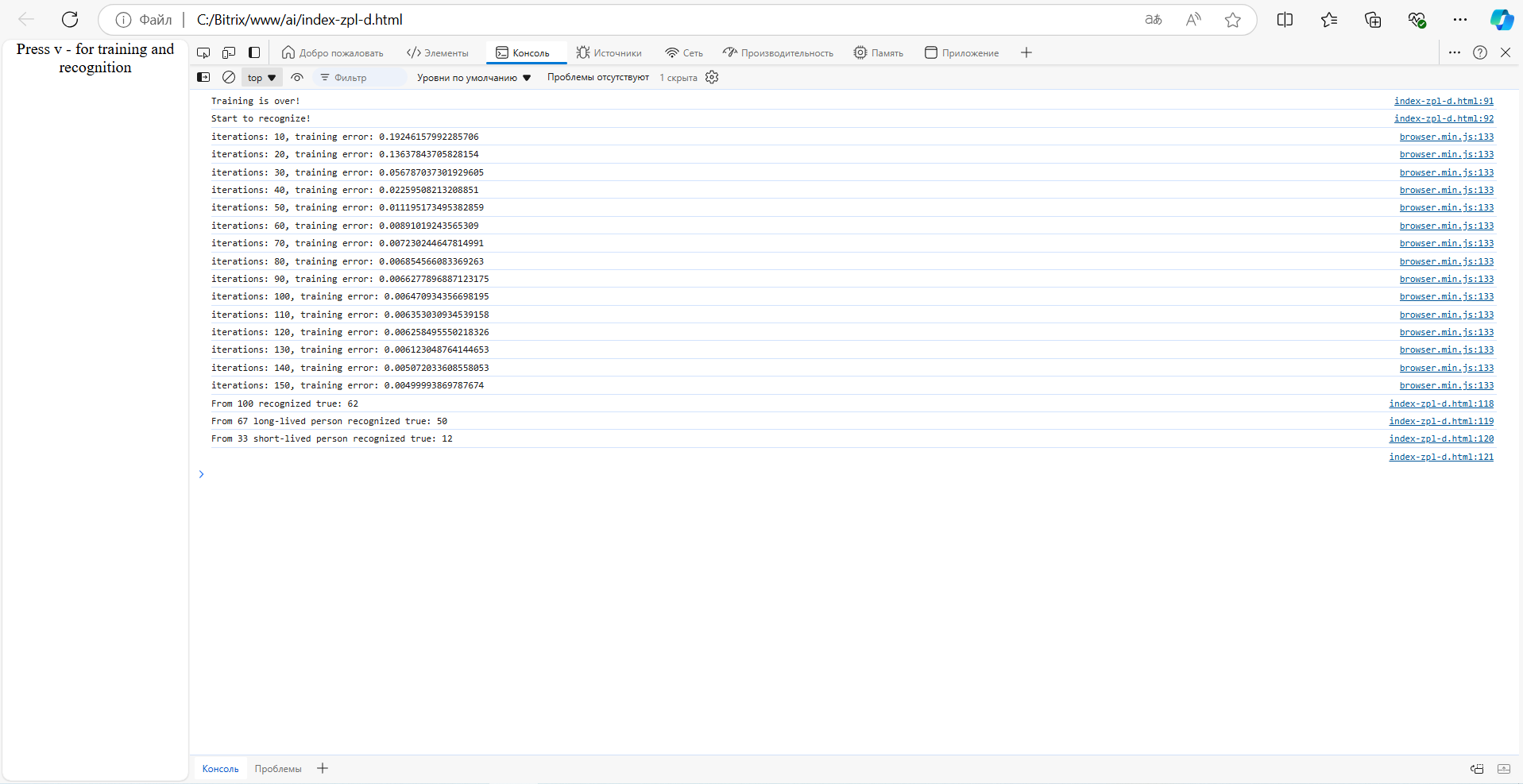
There is an element of randomness at various stages of the neural network's data processing, so the results will differ slightly from run to run. For this reason I ran the algorithm 10 times to compute the average value for the recognized cases.
Here is what came out:

Overall, 65.4% of the horoscopes were recognized correctly. This is substantially better than a figure around 50% for random choice, when, for example, flipping a coin, we say "long-liver" on heads or "short-lived" on tails.
All the results I write about (the current ones and all that follow) are collected in the file Results.xlsx (download)
Maybe It Just Seemed So?
According to the notions of modern science, the positions of the planets in a person's horoscope are pure chance. So let's feed in random planetary positions and see what the neural network can recognize in that case.
In the same proportion: 900 horoscopes where the positions of the Lagna and the planets were generated randomly are used for training, and 100 similar randomly generated ones for recognition. I kept only the values of the variable voz (the long-liver flag, 1 or 0) and vozt (the test ones) from the original database, so that the ratio (proportion) between long-livers and the rest would be preserved.
Just as above, the data for the neural network is organized in the file obnie-rnd.js.
You can run the neural network with this data here (open your browser's Console): index-rnd.html
Here is what came out:

As we can see, the results are noticeably worse (by 9.3%), but even on random data the neural network turns out to be slightly better than simply tossing a coin with 50/50 odds. Why that may be so — read on.
And how will the neural network cope if we train it on real data but recognize random data, or vice versa? If everything is random, we should not notice any particular difference...
To make the random data look more like real horoscopes, I took one detail into account. Mercury never moves further than one sign of the Zodiac away from the Sun, and Venus never further than two. I accounted for this feature when preparing the random horoscopes for these two tests. In all other respects the data is identical in structure.
obnie-rnd-or.js - the data arrays where training is done on real data from the horoscope database, and recognition on random data.
You can run the neural network with this data here (open your browser's Console): index-rnd-or.html

obnie-rnd-tr.js - the data arrays where training is done on random data, and recognition on real data.
You can run the neural network with this data here (open your browser's Console): index-rnd-tr.html

We can see that in this case the neural network performs even worse than if we tossed a coin at every choice. This means there are serious differences between the real data and the random data. What exactly they are remains to be determined.
The Problem
The first results with recognizing the horoscopes of long-livers and the short-lived inspired me. But there is one problem in the outcome: the neural network singles out one group (the long-livers) and recognizes it considerably better than the other - 77% versus 40%. And at the same time, long-livers turned out to be substantially more numerous in the database.
A neural network is able to adapt to the source data. Getting more long-liver cases during training, it may, when uncertain, lean more often toward choosing that group. Thus, if the database contains, say, 67% long-livers, then by always choosing in favor of that group the neural network will show a success rate close to that same 67%, which would not allow us to say that the recognition was done correctly and that there is a tangible difference between the two groups of horoscopes.
In our case it is evident that the neural network handles identifying long-livers better, but "limps" in the second case. The situation is substantially better than in the scenario I described, where the choice always goes to the more numerous group. But for us to be confident that the AI really does recognize horoscopes correctly, the neural network needs to be able to identify both cases with a probability above 50%. So I continued the experiments.
Three Groups of Longevity
Now I divided human longevity into three groups, as is done in Indian astrology. If the lifespan is less than 36 years, it is a short life. If it is more than 72 (twice 36) - a long one.
I removed from the database the horoscopes of those who lived from 36 to 72 years and reduced the number of long-livers so as to even out the sizes of the two groups a little.
That left just 193 cases in total, of which the last 60 were taken for recognition. Not many, but my other trials showed that even 100 cases for training are already enough for the NN to show a decent result at recognition! If there are more cases, one can expect the recognition accuracy to grow (that is how it was in my trials).
360 Shades of Gray…
Later I began feeding the NN not 0 and 1, but the position of the Lagna (ascendant) or a planet reduced to a value from 0 to 1. To do this, we take the planet's longitude measured from 0 degrees of Aries and divide it by 360 degrees. The resulting number will reflect the planet's position on the ecliptic (in the Zodiac).
When we feed the neural network's sensors a number from 0 to 1 rather than strictly 0 or 1, we in effect allow the AI to "see" not a black-and-white picture, but one with shades of gray. As a result, the volume of data shrinks (the "picture" is smaller in size), while the speed and accuracy increase!
An example. Real data - 900 cases for training and 100 for recognition. We pass the longitude of the Lagna and the planets as a number from 0 to 1 (the longitude from 0 deg. Aries to 360, divided by 360).
See: index-pospl.html

Results in the Group Under 36 and Over 72
Right here you can see (and verify) the data for training the NN (neural network):
obnie-36-72.jsHere you can run the neural network for training and recognition (it takes a long time; open your browser's Console):
Here are the results:

The overall accuracy stayed roughly the same as in the first case (66%), but the accuracy for the short-lived climbed past 50% and reached 54%, just as I wanted. True, the accuracy for long-livers dropped from 78 to 71% along the way.
Now I can say that the AI tells apart the horoscopes of long-livers and the short-lived and recognizes both groups, though not equally well.
Can a Neural Network Distinguish the Horoscopes of People of Different Professions?
To figure this out, I took the AstroDataBank database of 29 000 horoscopes. This database found its way onto the internet many years ago and has been distributed, for example, with the Zet astro-processor for more than 10 years.
Download the SADC archive from the Zet website
Download a copy of SADC-ALL.zbs from my LaGna website
This data contains the same characteristics as described in the "Horoscope Database" section on this page. I selected Rodden ratings A and AA and birth dates after 1800. The labels in this database make it possible to select the professions ACTRESS (actresses; actors have a separate label there - ACTOR) and MILITARY (military men from various branches of service, most often high-ranking). For the former the variable voz = 0, and for the latter – 1.
That gave 1603 horoscopes. Of these, the last 112 were set aside for recognition, of which 38 belonged to military men and 74 – to actresses.
I quickly checked the database for duplicate horoscopes and found none. I assume all the records are unique, but even if there are duplicates (for example, one person appearing under different names) – such cases are extremely rare.
Of the flaws I noticed during the check, the only one was that Bruce Willis ended up on the list of "actresses". This is probably an amusing typo that may have been fixed in newer versions of the database. But, jumping ahead, I will say that the neural network distinguishes actors from military men just as well as it does actresses from military men.
The Neural Network Recognizes the Horoscopes of Actresses and Military Men with an Accuracy of 80 to 83%!
Right here you can see (and verify) the data for training the NN (neural network).
Here you can run the neural network for training and recognition (it takes a long time, since the data is fed to it in a 0-or-1 format for each planet and for each sign of the Zodiac it can land in; open your browser's Console).
Here are the results:

The overall accuracy is about 76%. Separately for military men – about 61%, for actresses – about 80%. In other words, we see that the NN confidently recognizes the horoscopes of both actresses and military men at the same time!
Now let's feed in the same planetary positions, but in a different format: the planet's longitude from 0 deg. Aries divided by 360 deg. That is, as a decimal fraction in the interval from 0 to 1 (with "shades of gray").
Right here you can see (and verify) the data for training the NN (neural network). It also contains the data where I experimented with excluding planets from the array for training and recognition.
Here you can run the neural network for training and recognition (it runs fast; open your browser's Console).
Here are the results:

The overall accuracy is about 81%!!! Substantially higher than in the previous study. 78% of military men and 82% of actresses were identified correctly! Later it turned out that even these numbers are not the limit… But more on that below.
A Matter of Chance?
Let's compare the results obtained on real horoscopes with random data fed in the same format. We take into account that Mercury never moves farther than 27 deg. away from the Sun, and Venus - farther than 48 deg. I keep the values of the voz and vozt variables from the real database, so that the same proportion between the two groups is preserved.
Right here you can see (and verify) the data for training the NN (neural network).
Here you can run the neural network for training and recognition (it works fast; open your browser's Console).
Here are the results of its work:

The neural network stopped recognizing military men and switched to those who outnumber them in the database - the actresses. It probably began to treat every case as an actress, and by doing so picked almost all of them, obtaining a result of 92% for actresses and only 2% for military men (!). It is only thanks to the actresses that the overall success rate is around 62%.
Among the cases for recognition, 74/112 = 0,66, or 66%, are actresses. The proportion in the training database will be about the same. This means that if we always, or almost always, identify the horoscope presented to us as belonging to an actress, we will show a result of about 66%, which is exactly what happened. Thus, the neural network failed to find clear criteria to tell one group from the other and started predominantly labeling every case as belonging to the group of actresses. That is why, on random data, only 2% of military men were identified against the background of 92% of actresses.
In the future I may build a database with equal numbers of actresses and military men; I think this will bring the success rate close to 50%, or even lower, for random horoscopes...
Some Conclusions
The precise language of mathematics demonstrates to us that the time of a person's birth is not a matter of chance! And it is also obvious that a correlation exists between the positions of the planets in the birth horoscope and a person's profession; otherwise the machine would have had no way to distinguish, with impressive accuracy, representatives of one profession from another by the pattern of the star chart, as we saw it do on real and random data.
This means that there are quite definite causes that precede a person's birth, and these causes then have consequences we can observe, which are expressed in the choice of profession, the length of life and other elements of a person's destiny.
There are no grounds whatsoever to believe that this chain of causes and effects, called "destiny", is exhausted, or disappears, or must be cut short the very moment a person dies.
It is also logical to assume that in one form or another there exists "a certain agent" or "carrier of destiny", which is usually called the soul (jiva) or the Spirit (Atma). And it already existed before the person's birth, so as to bring with it, at the right moment of the year, the "seeds of causes" that will sprout in the soil of material existence and bear their inevitable consequences. Just as a mango tree will grow from a mango seed, and a pea bush from a pea, – all the accumulated causes will, sooner or later, bring the consequences that strictly correspond to them, and the "harvest" gathered in this way will lay down new causes, continuing the chain…
Since the causes laid down by the "agent of eternity" (the soul) during life (material existence) must, in time, lead to their natural consequences, and all such consequences cannot possibly be exhausted within one single human life, – it is right to assume that "this music will play forever", and the soul will once again appear on the "stage of life" to collect the "applause" it has earned…
Cracking the Dogmas
Since the age of 7-8 I have been fond of the game of Go. It is an intellectual Eastern game that is often compared to chess, although the two games have nothing in common… In both cases, two sides "battle" on the board: Black against White, making moves in turn. That is where the similarities end. In Go the sides divide the board, placing their "stones" so as to "fence off" the larger part of the territory for themselves. Individual stones and even whole groups can be taken prisoner, which makes the game very dynamic and rich in possibilities.
Before my eyes a "drama" unfolded, in which the machine, helpless at first, began to feel ever more confident, until it got the upper hand over man.
At first the machine was taught to copy humans, and it went extremely badly. Even a beginner who had barely learned the rules could beat the best programs. Because the dimensions of the Go board are much greater than those of the chessboard, and the number of variations approaches a figure exceeding the number of elementary particles in the Universe, – the method of enumerating all the variations was useless. At some point it seemed that Go was simply too tough a nut for the machine. In the 2000s we used to make playful bets. Someone said the machine would crack the game within 10 years, while I felt that this was hardly enough time…
I no longer remember who won that argument, but very soon the "Monte Carlo" method was proposed to improve the "computer player". Its essence came down to the following. The program did not try to enumerate all the variations, but took only a few of the most probable ones and played several thousand games against itself at the most primitive level, – merely not breaking the rules of the game and bringing every "virtual" game to its finish. Playing against itself "on equal terms", the program gathered statistics – which of its moves led to victory more often. Then it made a random choice among several of the most promising move options.
Even this simple approach allowed the machine to leave most Go amateurs behind, but not the professional players, who in Asia form a separate privileged league, – the "blue blood" of intellectual art, or sport, whichever you prefer.
After that, events unfolded even more swiftly. In 2015 there appeared the program AlphaGo, developed by Google DeepMind. At first it consisted of three modules. The first module contained a huge database of games played by professional players, on which the neural network was trained. After training, it could predict the moves of a professional player with high probability. The second module contained the already mentioned Monte Carlo algorithm, within which the trained neural network now played against itself. The third module allowed the program to learn from the results of the two previous ones, for deep learning of the neural network.
The chosen approach allowed the program to begin its triumphant march up the Olympus inhabited by the "legends" of the professional Go world. Beating them one after another, the program reached the strongest player (the Korean Lee Sedol was second or fourth in the world ranking at that time), who managed to keep only one game out of five. The champion capitulated, and his single victory, as became clear some time later, was caused by an effect known as a "neural network hallucination". In later versions of the program this "bug" was probably fixed, after which the timid ray of hope that man could fight the machine, and at least occasionally beat it, - faded away…
However, what happened next - forgive the crude expression - turned into a real beating of the "leather bags". That is what Zen masters used to call negligent students who fell asleep during meditation, for which they received an invigorating blow on the back with a bamboo stick…
A new version of the program appeared, AlphaGo Zero, which differed from the previous one first of all in that everything human had been thrown out of it, namely the first module with the professionals' games on which the "first stage" of the neural network had been trained.
"Zero" began its training from scratch, from a clean slate, playing only against itself. Gradually gaining experience by playing against its own previous variations, this neural network in a matter of days surpassed the version of AlphaGo that only recently had left no chance to the champions among the pros. AlphaGo Zero beat its previous version with a score of 100 / 0. It turns out that the professionals' games on which the first version had been trained were only preventing the program from playing better!
It was a very painful experience, not only for me but for many who had spent years immersing themselves in the subtleties of this strategic game.
Replaying on the board the games of legendary figures of the past, studying the subtleties of the four Go houses competing for the title of "Meijin" ("Master"), analyzing the "ear-reddening game" of the kisei ("holy player") Honinbo Shusaku, leafing through antique Japanese "kifu" (notebooks with game records), absorbing how the concepts of the game evolved from ancient times to the brilliant revolution of master Wu, reviewing the games of professionals from South Korea and China with commentary by modern champions, I could never have imagined that some two-year-old digital upstart, a ridiculous "electronic Frankenstein" of our days, would send all of this to the scrap heap of history, showing that all this knowledge and all these concepts may only be getting in the way of our playing Go! And if we had trained having freed our mind from almost all concepts right away (except for the rules of the game), then perhaps we would have achieved a better result than by moving along bent under the crushing load of outdated dogmas…
Shortly before the appearance of AlphaGo, a debate unfolded among professional players about what handicap they could take to play against the Go God — an abstract player who never makes a mistake, always choosing the best move in every position. The masters' opinions did not differ much: some assumed that two handicap stones would be enough for him, while to the bolder ones it seemed that one, or even half a stone, would do… This discussion meant that we imagined the theory of the game had reached a certain perfection and the players had almost no room left to grow — they were already standing one step, or even half a step, away from the absolute ideal.
In reality, we were at the summit of our own ambitions, not of mastery. The experience with AlphaGo and its subsequent versions showed that there may be no limit to perfection at all, and we are still very, very far from the ideal — certainly not one or two steps away…
Forgive me if I have drawn out this "preface" to the next part of the study, but it was done deliberately, because as we move further, both those who practice astrology and those who deny it may face a situation where they will have to set aside everything we knew before and approach the facts with an open, unbiased mind.
Under "Crossfire"
In recent centuries astrology has come under the crossfire of both the theologians of the Abrahamic religions and scientists with a materialistic worldview. The few who, like Michel Gauquelin, tried to defend astrology's right — if not to be recognized, then at least to be studied — were pelted with rotten tomatoes from all sides.
Theologians mocked it, saying that only the Almighty knows and decides the destinies of the world, although nothing speaks against the idea that the planets, created by that same Creator, could serve in His own hands as intermediaries of the higher will, and perhaps even of justice, like the archangels. After all, the head of a state does not run after every criminal himself, but establishes a law-enforcement service in the state...
Instead of personally watching over every sinner (is that not too great an honor?) and then punishing him as needed, would it not be better to create, once and for all, a "mechanism" — impassive and just — that would return to every living being, as they ripen, the fruits of its efforts, both good and bad? Such a "feedback system" could be self-learning and could gradually evolve without direct intervention.
I am certain that the planets have not only their own place in the universe, but also their own functions in it, some of which concern you and me. It is quite possible that, in setting the cycles of time, the planets bring along with them the fruits of one or another of our deeds…
On the other side stand the scientists, who, instead of doing research in this field, have for more than 200 years been furrowing their brows composing lampoons against the celestial muse. They are not stopped even by the fact that the entire "edifice of science" rests on a foundation laid by the works of ancient philosophers, astrologers, alchemists, metaphysicians and mystics . Nor by the fact that they have already erred badly and absurdly in their conclusions more than once (recall such "pseudosciences" as cybernetics and genetics, while amid the campaign against them the works on "Michurinist agrobiology" and "vernalization" by the repeatedly decorated academician T. D. Lysenko came out in editions of millions of copies) — and science still has no complete picture of the world.
What is consciousness, how is a thought born in the brain (or beyond it?), what factors determine/change the nature of a thought and its flow? Does science have exhaustive answers to these questions? Thoughts determine our choices and behavior, and therefore our destiny, yet we still have only a general notion of how the process of thinking unfolds. And what if this very process is influenced by the mutual arrangement of the planets, as they believe in India?
Perhaps modern science knows how the atom is built? There is not even a model of the atom unambiguously accepted among scientists, nor an understanding of all its constituent parts, to say nothing of much else in "living nature". How can one deny anything in a field of which there is no complete knowledge? As long as the process of cognition is not finished, one cannot state definitively what can exist in this world and what cannot. That is, at the very least, unscientific…
Fewer Planets – a Better Result.
How can we tell which planets contribute more to the accuracy of recognizing a pair of professions, and which contribute less? I took the same pair of professions – actresses vs. military men – and began training the neural network on arrays from which I successively excluded the positions of the Lagna (ascendant) and the 12 planets, including the trans-Saturnian ones. What came out of this was unexpected for me…
I suggest we refrain from far-reaching conclusions for now, because a picture that holds true for one pair of professions may turn out to be invalid for another. Many more additional studies need to be carried out before the whole picture emerges before us.
Below you can see the results of the neural network's work when individual planets and the Lagna are excluded.
Table 1.
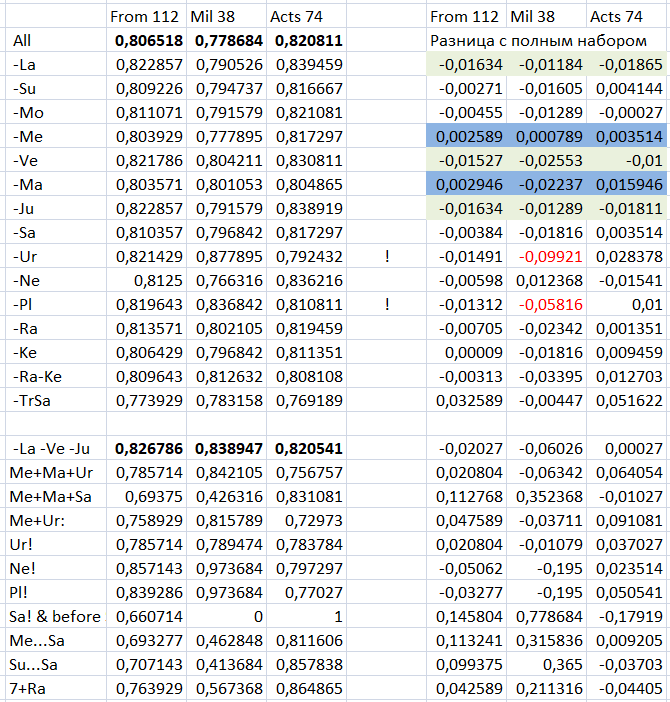
From the baseline (initial) results we subtract what we obtained in the tests without individual planets. A negative number means that the baseline case (All), with all the planets, was less accurate (less effective) than the calculation without one of the planets. Numbers below one percent (below 0,01) can presumably be disregarded, since they may fall within the margin of computational error.
It turned out that by excluding the Lagna position from the input data, the recognition results can be slightly improved! I was prepared for this news, because I have long been studying a branch of astrology called Bhrigu Nandi Naadi, in which the Lagna is simply ignored, and conclusions are drawn solely from the mutual arrangement of the planets relative to one another and from whether they are converging or moving apart.
But a similar effect also appeared for Venus and Jupiter (the rows highlighted in the table with a green background)!
For this I was no longer prepared.
What?! Venus was supposed to play an important role for actresses… Yet we exclude it, and the neural network only starts distinguishing the groups better (not significantly, but still…)?
And Jupiter, in the Bhrigu Nandi Naadi school, replaces the Lagna and is essentially the first planet in order of importance! If you are the hero who has read this far, you understand why I needed the text about "AlphaGo" myself and why it grew so long…
The table row that begins with the cell "-La -Ve -Ju" contains the totals of calculations in which these three parameters were excluded. The overall accuracy of group recognition increased by a couple of percent. This number is not exact – it may become slightly smaller or larger if the number of tests is increased – but it shows the trend.
So, we can exclude the Lagna and these two planets without any harm to the recognition… As I noted at the beginning, it is premature to draw conclusions, but this fact in itself gives food for thought.
It is noteworthy that excluding Mercury and Mars worsened the recognition (a positive difference from the baseline case), though insignificantly (less than one percent). Such a small influence does not rule out that it lies at the level of computational error. This can only be verified by bringing the statistics up to at least hundreds of outcomes.
I also noticed that within the group of military men, accuracy was strongly affected by the exclusion of Uranus (10%) and Pluto (5,8%). These numbers are highlighted in red.
Astrology often uses "yogas," or combinations – patterns formed by the conjunction and mutual arrangement of several planets. So I decided to try taking only a few planets for recognition, assuming that they might influence the choice of profession. You can see the results opposite the table cells labeled: Me+Ma+Ur (we take for recognition the coordinates of Mercury, Mars and Uranus), Me+Ma+Sa (Mercury, Mars and Saturn), Me+Ur (Mercury and Uranus).
The recognition results got worse, especially in the Mercury + Mars + Saturn group, but were still stable… How many heads must be "chopped off" this "Hydra" to deprive it of its ability to discriminate?
Then I tried running the recognition on a single planet only – separately on Mercury and separately on Uranus. I expected that the neural network would be unable to orient itself by the single position of one celestial body. Indeed, when we feed only Mercury's position to the network's sensors, it sees no difference and counts everyone as "actresses," since this group is larger, and the overall result will be 66%. This is exactly what the "recognition" result should be if every case is labeled as an actress – that is 74 cases out of 112, or 66%.
But with Uranus one more surprise awaited me. The neural network confidently distinguished actresses from military men by a single coordinate of the planet, and in both groups at that! About 78% correct both overall and within the groups.
I had to take each planet and test it separately. It turned out that a similar effect also holds for Neptune and Pluto. Moreover, Neptune showed the highest performance of all the experiments whatsoever – 85,7% overall, 97,3 for military men and 79,7% for actresses.
But that's it then, a skeptic will think: the whole trick rests solely on the slow planets that mark off epochs, and we may suppose that there were times which, out of historical necessity, focused our attention on military men, and then a period began that was favorable for the talent of actresses to unfold…
No, that is not all. First, the neural network recognizes the professions perfectly well even without the trans-Saturnian planets, though with slightly lower performance. See the row opposite the -TrSa cell: 77,4% overall, 78,3% in the group of military men and 76,9% in the group of actresses. And at the same time, not a single planet, apart from the trans-Saturnian ones listed, makes it possible to distinguish the professions when taken alone. The same goes for the Lagna.
Second, the neural network distinguishes other groups of professions well too: for example, it tells beauty models apart from philosophers (78% overall and within the groups), as well as actors and musicians, which will be discussed further on. And here it is already hard to argue that there could be epochs most favorable first for one category and then for the other.
Third, further research is needed to understand whether the effect for the trans-Saturnian planets disappears on a larger amount of data and for other professions, or whether it is stable. In any case, from the standpoint of modern science, to claim that certain characteristics of entire epochs of Earth's history can be "set" by the positions of the planets, including the trans-Saturnian ones, is in fact the same as proving that "astrology works" – for there should be no correlation whatsoever between the positions of celestial bodies and earthly affairs, as modern scientists believe. I emphasize the word "believe," because science has no factual data that would directly and unambiguously prove the absence of such a connection or of its possibility.
Rather the opposite: it is well proven that the cycles of solar activity comprehensively affect many aspects of life on Earth, even including supermarket prices. However, it has not been proven that the positions of the planets can, in their turn, provoke varying intensity of this activity. But even that does not explain the influence of the planets on the fate and the "free choice" of profession of an individual living being. I think this influence extends not only to people, but to everything that exists "under the Moon".
In the last rows of the table you can see that I ran the recognition on data that included only 5 planets (Me...Sa): Mercury, Venus, Mars, Jupiter, Saturn. Then I added to these planets the Sun and the Moon (Su...Sa) and, finally, Rahu (the north lunar node) – "7+Ra" (overall accuracy 76,3%). With each addition the accuracy grew, but the figures are at their best when we use the Lagna and 9 planets (not counting the trans-Saturnian ones, which were not used in antiquity) – 77,4%.
Michel Gauquelin Says Hello to His Haters!
Michel Gauquelin and his wife Francoise did a tremendous amount of work, collecting thousands of birth charts of politicians, military men, actors, musicians, and so on. It would be strange to walk past this database without checking whether the neural network could tell pairs of professions apart in this case too…
While I was working on this study and article, for some unknown reason the official CURA website would not open at this link:
https://cura.free.fr/gauq/17archg.html
So I used the saved copies of the pages in the Web Archive:
https://web.archive.org/web/20121005232443/https://cura.free.fr/gauq/17archg.html
The database 1473 PAINTERS (PEINTRES) & 1249 FRENCH MUSICIANS (MUSICIENS) A, vol. 4 : from 1796 to 1928
https://web.archive.org/web/20121023085725/http://cura.free.fr/gauq/902gdA4.html
The database 1409 ACTORS (ACTEURS) & 1003 POLITICIANS (HOMMES POLITIQUES) A, vol. 5 : from 1600 to 1944
https://web.archive.org/web/20121023083503/http://cura.free.fr/gauq/902gdA5.html
I took the data of the actors and musicians from these pages, removing the cases of birth before 1800. That gave me 1392 actors and 1248 musicians. While the AstroDataBank database provides separate labels (tags) for actors and actresses, the data collected by the Gauquelin family, as I understand it, includes both sexes at once.
I took the first 1000 records of each group (2000 cases in total) for training, and the next 200 for recognition (400 cases in total). Source data. Run the neural network (open your browser's Console).
Once again I found myself amazed. The neural network managed to correctly identify 91%, or 365 cases out of 400. In the actors group the result was 94%, and in the musicians group – 88,7%.

To be fair, I must say that I did not get this result right away, because at first I took the group of military men and actors for recognition, and there the figures were more modest (64%). It is hard to say what kept the machine from telling those two groups apart just as well. In any case, it would be wrong to compare that case with the pair of professions from AstroDataBank, since both the actors and the military men there were selected by different criteria.
Next, I decided to compare how the neural network would behave if the trans-Saturnian planets were removed from the data. The recognition accuracy dropped, which speaks to the great significance of these planets, but it still stayed at a level that rules out chance – the overall result: 69,4%, in the musicians group: 64%, in the actors group: 74,6%.
Now let us make sure we were not just seeing things. To do this, I kept the time, the coordinates of the place, and the time zone of the original records, but replaced all the birth dates with random ones (day, month, and year). The interval for the year of birth was taken the same as for the actors – from 1800 to 1944.
Quite predictably, the machine stopped telling the two groups apart, showing a result of 49,6%, which corresponds to the situation where we flip a coin to pick one of two options. Having assigned, say, heads to the actors and tails to the musicians, we will be guessing right in about 50% of the cases.
Then I thought that the machine might be "latching on" to the different time intervals and telling the groups apart better because of that. This time, while randomizing the dates in the source data, I preserved the intervals within which the year could fall: from 1800 to 1928 for the actors and from 1800 to 1944 for the musicians. Again, I took 1000 cases from each group for training and 200 for recognition.
These "random" databases can be viewed and downloaded here:
Indeed, the machine slightly improved its performance, showing an overall result of 54%, which is only marginally better than simply flipping a coin.
Later I found out that if the same number of days is added to both birth dates, the recognition is preserved. This can probably be explained by the fact that the planets move more or less in sync, and their shift over the same span of time resembles rotating (tilting), say, the symbols "A" and "B" by the same angle. Although the symbols get slightly distorted by such a rotation, the machine's overall ability to recognize them is preserved.
So I decided to "blur" the image of the group by adding a random number of days, from 1 to 45, to the birth dates. In doing so, I used only the data for the Lagna and the 9 planets excluding the trans-Saturnian ones; their exclusion is dictated by the fact that, for example, the aspect (angular distance) between Neptune and Pluto can persist for decades. Thus the sextile (an angle close to 60 degrees) holds, with one precision or another, roughly from 1945 to 2035.
The results for the group of actors and musicians after the "blurring" (adding a random number of days from 1 to 45 to the birth date) showed a drop in the neural network's performance down to 57%. The recognition quality sagged especially for the musicians group – down to 44%.
This again shows that there is a substantial difference between the group of charts ("pictures") that belongs to the births of actors and musicians as compared with arbitrary dates standing slightly apart from them. This may mean that the date of birth is not random, and that there is a correlation between the birth chart (horoscope) and a person's profession.
And One More Greeting from M. Gauquelin
But can the machine, having trained on the base of horoscopes from AstroDataBank, successfully recognize similar groups from M. Gauquelin's collection of charts?
We take the horoscopes of actresses and military men from AstroDataBank for training (1491 cases in total) and the same 400 cases from M. Gauquelin's database for recognition (200 each for actors and military men). Comparing these groups is not entirely correct, since the first group contains only actresses, while for recognition there are actors of both sexes. Also, the military men in AstroDataBank are usually high-ranking and known for something, while the criteria M. Gauquelin used to select his group still need to be clarified. Nevertheless, it is interesting to see what the neural network can do in this case! We pass in the longitudes of the planets from 0 to 1 (dividing the longitudes from 0 deg. Aries by 360 deg.) Lagna and 12 planets.
The overall success rate is 64%, with 37% for military men and 90% for actors.
The skew toward actors may have been caused by the perceptron's training not being uniform. In the source base, several cases of military men may come in a row, followed by a smaller number of actresses… I have noticed that the best results come from uniform training, when a case from one group is immediately followed by an example from the other.
Then I took the horoscopes of actresses and actors (450 cases each) as one group and musicians (900 cases) from AstroDataBank for training (1800 cases in total) and the same 400 cases from M. Gauquelin's database for recognition (200 each for actors and musicians). We pass in the longitudes of the planets from 0 to 1 (dividing the longitudes from 0 deg. Aries by 360 deg.) Lagna and 12 planets.
The success rate rose to 76%. In both groups, more than 50% of cases are recognized. 59% for actors and actresses and 93% for military men.
Data from the two databases for training. Run the neural network to train on AstroDataBank and recognize on Gauquelin's base (open your browser's Console).

This means that recognition does not depend much on who collects the source data, or how. The selection criteria for the groups could have been slightly different. AstroDataBank was filled mostly with notable people, or high-profile cases from all over the world and from the year 1800 (my cutoff) to the present day. At the same time, M. Gauquelin selected birth charts without being guided by the principle of a person's "notability" (if I am not mistaken) and, importantly, he mostly obtained data on Europeans who lived in Europe from 1800 (my cutoff) to 1928 (musicians), or 1944 (actors). Despite this, a perceptron trained on the data of one base confidently recognizes cases from the other.
It is magical!
Ethical Problems
I expect that my research will be comprehensively and systematically checked, studied and confirmed (or refuted?). And if it is confirmed, this opens up boundless horizons for the study and application of "neural network astrology". But the benefit from this can be just as large-scale as the harm.
Neural networks are just as much a tool, or an implement, as a stick. Ever since man took it into his hands, he has invented many improvements. A stick can be made into a hoe or a broom, a pike against a beast, or a lever. But you can also use it to whack a neighbor who does not look like you and me, and is therefore a "stranger", suspicious and dangerous…
Artificial intelligence, based on neural networks, in the hands of malicious people will soon come to resemble the "beast" of the Apocalypse that crawled out onto dry land to torment us. Overwhelming in its superiority and antihuman (inhumane), it could have been different if there had been more responsibility in the people creating it, and if the principles of ethics had become a "thou shalt not cross" line, capable of shielding humanity from great evil, or from harm to its own kind. But it is what we train it to be. And in this sense it is not only our offspring but also our reflection, in which, as in a mirror, we will be able to see ourselves as we really are.
Is AI to blame for the fact that we want to digitize (tokenize) and divide up the whole world, creating a new digital feudalism, or even digital slavery? Is it to blame that we endlessly divide the world along borders that do not actually exist and strive to assign to every little piece an owner who will extract profit from his allotment, real or virtual? After all, all these borders and allotments exist only in our minds and nowhere else, yet we are ready to argue about them endlessly and to move them back and forth…
We are locked in the prisons of our minds, in "little boxes" with impenetrable walls of convictions, dogmas, stereotypes, unconscious reactions and other useful rubbish. And there is only one way to leave this voluntary seclusion – to come to know within ourselves the life of the soul and the spirit, the spontaneous, unconditioned foundation of our existence. To gain freedom through creativity, inspiration, illumination, intuition and good will toward those around us (the urge to help).
Can happiness be achieved by causing unhappiness to those around you? The answer to this question has always seemed obvious to me: "no". But just recently I came across how a neural network answers a similar question.
This is "written" by a language model, which in a certain sense generalizes the multitude of texts it was trained on. Roughly, the answer can be broken into two parts: "yes, because that is how this damned world works" and "no, we ought to be kind to one another, otherwise it is unethical"… That is, decide for yourselves, in the end: either come to terms with "reality" or keep on dreaming, — both approaches are acceptable.
In reality, the situation is such that a human being is not capable of surviving alone, only in a group. Not only in childhood or in old age, but throughout our entire life we depend on other people completely, 100%. Our thoughts and convictions are borrowed from teachers, our clothes come from seamstresses, our food from grain growers and bakers, our shelter from builders. Through our own work we try to repay these people, and in the modern world money has become the equivalent of gratitude. Once upon a time it was enough simply to "remember and keep gratitude", so as to repay it when a suitable occasion arose, or to "pay it on to others".
In our time, money is thriving, while gratitude has begun to slip away… The last little island where money has not yet conquered the whole world remains the family, where we try not to convert mutual services and support into a monetary equivalent. But let us take the situation to the point of absurdity in order to make it more vivid.
So, the wife asks her children and husband for money for cooking their food and cleaning the house. The children take money from their parents for food and schooling as a loan, to pay them back when they grow up. Kissing her son goodnight, the mother enters the service into the "register of services rendered"; later the son will pay for it according to the price list, adjusted for inflation. The husband pays for the "family's services" and issues it loans, and also takes his percentage for protection. A "kind look" today goes at double the rate, while a "scene of jealousy" can be ordered at a 50% discount. Tomorrow the family is having a "sale" on laundry — everyone has to hand in their things in time. So as not to miss anything, let us automate, digitize and tokenize these processes.
Will such relations not make them all strangers to one another (every man for himself), lonely and unhappy? Will even one of them be happy surrounded by other deeply unhappy people? Imagine that everything connecting you with the people close to you is debts or loans, obligations to render services and the like. Will people driven only by such mutual settlements not turn into something like machines or robots?
And now let us imagine that the whole world is one big family and we are all relatives, connected to and dependent on one another. Is not the very same thing happening in our big family? Will we be able to be happy in such an environment, with such an attitude toward one another?
The opposite approach could be a commune (a group of families) — a free association of people with similar spiritual convictions, with shared aspirations and approaches, within which commodity-money relations would not dominate. The risk of stagnation and of such a commune turning into a totalitarian sect can be overcome through regular and mandatory rotation of the leaders or leading families.
Yes, such groups will be created and will fall apart until some of them find some stable form of existence, but this is a natural and expected process of refinement.
Experience and research show that surrounded by like-minded people who care for one another, a person can be truly happy and live a life filled with meaning.
It seems to me that the urge to give thanks (to be useful) is built into living beings at the same instinctive level where the reactions to stress are stored: aggression, flight, freezing. The reaction opposite to stress must also be present at the deepest level, and that is the urge to bring benefit (i.e., to repay with gratitude). For example, cats bring their owner the mice they caught at night in gratitude for being cared for. Is this a conscious action or an instinct?
Taking Responsibility
Responsibility for the use of neural networks is personal, just as with the use of any other tool. And it seems that the soul takes the consequences of its deeds along with it if it does not manage to face them within its lifetime. How else can one explain that "choice of destiny" which is embedded in the date of birth?
In ancient times the powers of astrology were regarded with awe. Rishi Parashara wrote (BPHS 2:8-13):
"He who knows all the grahas (planets) will become versed in the knowledge of the past, the present and the future. No one can comprehend this without the knowledge of astrology. Therefore everyone should study this science, and especially the Brahmins. He who reviles this science without knowing it will go to the hell called Raurva and will be born blind."
"Will be born blind" does not necessarily mean being "deprived of eyesight." There are people who have eyes yet do not see. This expression, as it seems to me, may refer to a lack of understanding or comprehension.
He also describes what a student of the science of destiny should be like:
1:5-8. … Only those students should be taught the science of Astrology who are worthy and peaceful, who honor their teachers and elders, who speak only the truth and who revere God. Only then will there be good. This science must not be taught to unwilling students, skeptics, unbelievers (atheists), or treacherous and cunning people.
It would be wonderful to extend these principles to everyone who approaches the study of any science and the application of the knowledge gained. If this attitude is followed in all areas of life, there will be no harm. But, neglecting ethics, science is moving toward the creation of yet another Frankenstein...
Conclusions
1. The fact that the neural network confidently recognizes the horoscopes of representatives of different professions (for example, actors and musicians from M. Gauquelin's collection), with an overall success rate of up to 91%, both when it receives them as a black-and-white picture (the positions of the planets in the signs of the Zodiac: 0/1) and when a grayscale "image" is fed to its sensors (the positions of the planets from 0 degrees of Aries in the interval from 0 to 1), indicates that there exist distinguishable combinations, or patterns of the mutual arrangement of the planets, which correlate with the choice of certain professions, and this proves the concept of astrology.
2. This is also confirmed by the fact that when random planetary positions or random birth dates are used, no such picture is observed. And also by the fact that when we try to train the neural network on real data and have it recognize random data, or vice versa, the overall success rate only drops, sometimes below the expected 50%.
3. Stable recognition of representatives of two professions is observed on source data collected at different times, by different people, with possible small differences in the selection criteria, and for places far removed from one another. Thus, by training the neural network on data from the AstroDataBank and using data from M. Gauquelin's collections for recognition, we obtain an overall success rate of 76%. For this we take the horoscopes of actresses + actors (450 cases each) and musicians (900 cases) from the AstroDataBank for training (1800 cases in total) and 400 cases from M. Gauquelin's database for recognition (200 each for actors and musicians).
4. The neural network is able to distinguish horoscopes both when using 10 planets (please do not confuse the astrological term "planet" with the astronomical one — these are different concepts) and when using the septener (7 planets) that the ancients worked with, albeit with lower accuracy.
What contribution each of the planets and the Lagna makes to the recognition success rate in different groups still remains to be clarified. It is now obvious that this contribution differs, and in both directions (for better and for worse).
So far it has been found that the neural network can distinguish some groups of horoscopes based solely on the positions of Uranus, Neptune and Pluto. For the other planets no such property has been revealed yet.
5. Besides recognizing the horoscopes of people of different professions, the neural network was able to show a good result (66%) in distinguishing the horoscopes of long-livers and short-lived people. These data require confirmation on a larger sample of horoscopes, but usually the recognition accuracy only grew as the training base was enlarged. Nevertheless, we must wait for new studies to confirm this fact.
6. I am sure that the data I have obtained can be significantly improved with the help of the additional capabilities that neural networks possess, for example, by grouping them together at different stages.
7. Proving astrological concepts implies that destiny exists as an interconnected chain of causes and effects. Destiny, as the accumulated sum of causes not yet realized, leads the subject (the "agent of destiny," the bearer of destiny, or the soul) to be born at the moment in time that corresponds to the opportunities for the ripening and realization of the consequences of past deeds. Receiving the fruits of its deeds ("as you sow, so shall you reap") and laying down new causes by its actions, the soul does not manage to exhaust them within a single life and is forced to return to this world for a new birth, in order to meet the consequences of its efforts once again.
8. We can expect that quite soon new studies will appear confirming astrological concepts with the help of neural networks. I think that many discoveries lie ahead of us, which will touch not only the field of astrology, where we will encounter a new, unexpected view of old truths, but also the field of traditional science, which has gotten "stuck" in archaic materialism.
D. V. Solncev 21.09.2024